
I always liked stories about eccentric royals doing mad things.
Queen Christina of Sweden reportedly had a miniature cannon made for firing tiny cannonballs at fleas in her bedroom. Louis XIV made a proto-reality-show of his daily routines, allowing an audience of courtiers the honor of watching him dress, bathe, and use the toilet.
Peter the Great famously returned from a tour of Western Europe, and refused to let men have beards near him. Intent on “modernizing” Russia, he personally shaved many of his noblemen, and implemented a beard tax.
The weird behaviors of aristocrats always seemed especially fanciful to me. We probably only know about their quirks because they had the power to make others take them seriously.
When a famous person expresses a novel form of madness, it sometimes catches on. In the 1390s, Charles VI of France came to believe he was physically made of glass. Insisting he could be easily shattered, he wouldn’t let people touch him, and had iron reinforcing rods sewn into his clothes.
In the centuries that followed, this same odd delusion reappeared several times, all in members of the educated classes. From Fear and Fragility: The Glass Delusion and its History by Tamara Sanderson:
The physicians André Du Laurens and Alfonso Ponce de Santa Cruz independently documented a nobleman who believed himself to be shaped specifically like a glass pitcher. Not merely made of glass, but also contained by it: he slept buried in straw, terrified that he might tip in the night and pour himself out across the floor.
[…]
The Dutch physician Levinus Lemnius, writing in the mid-sixteenth century, treated a patient who was rational and highly functional in every respect save one: the absolute conviction that his buttocks were formed from the same stuff as windowpanes.
My first reaction was that this was all very funny, especially the illustrations. There’s something about art depicting European nobles, with their tights, decadent hats, and throngs of attendants, that makes it hard to take their distress seriously.
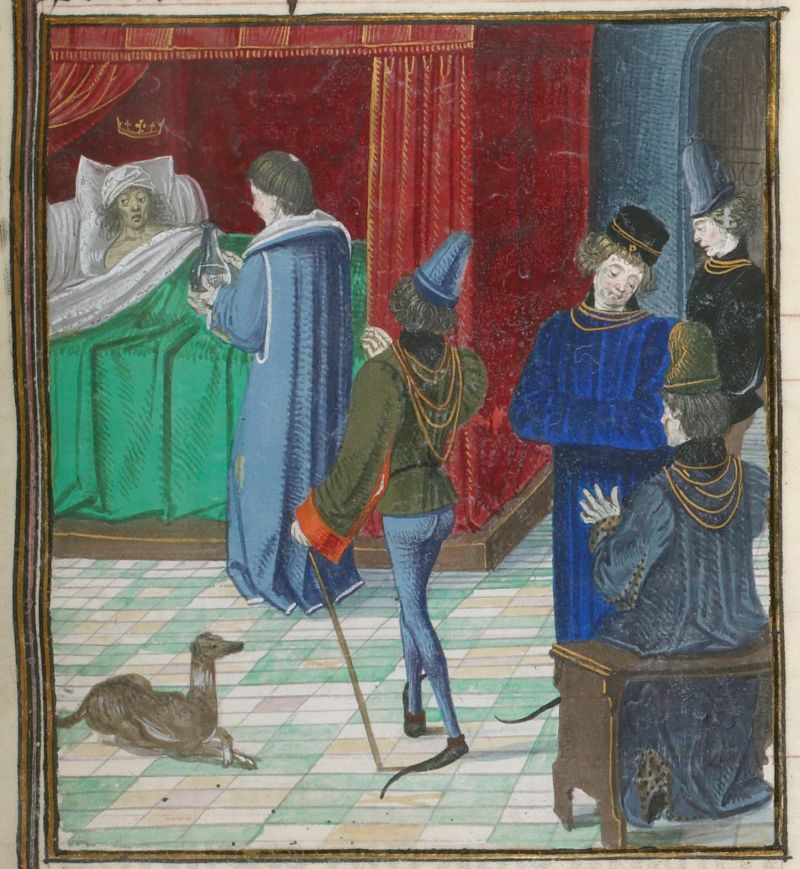
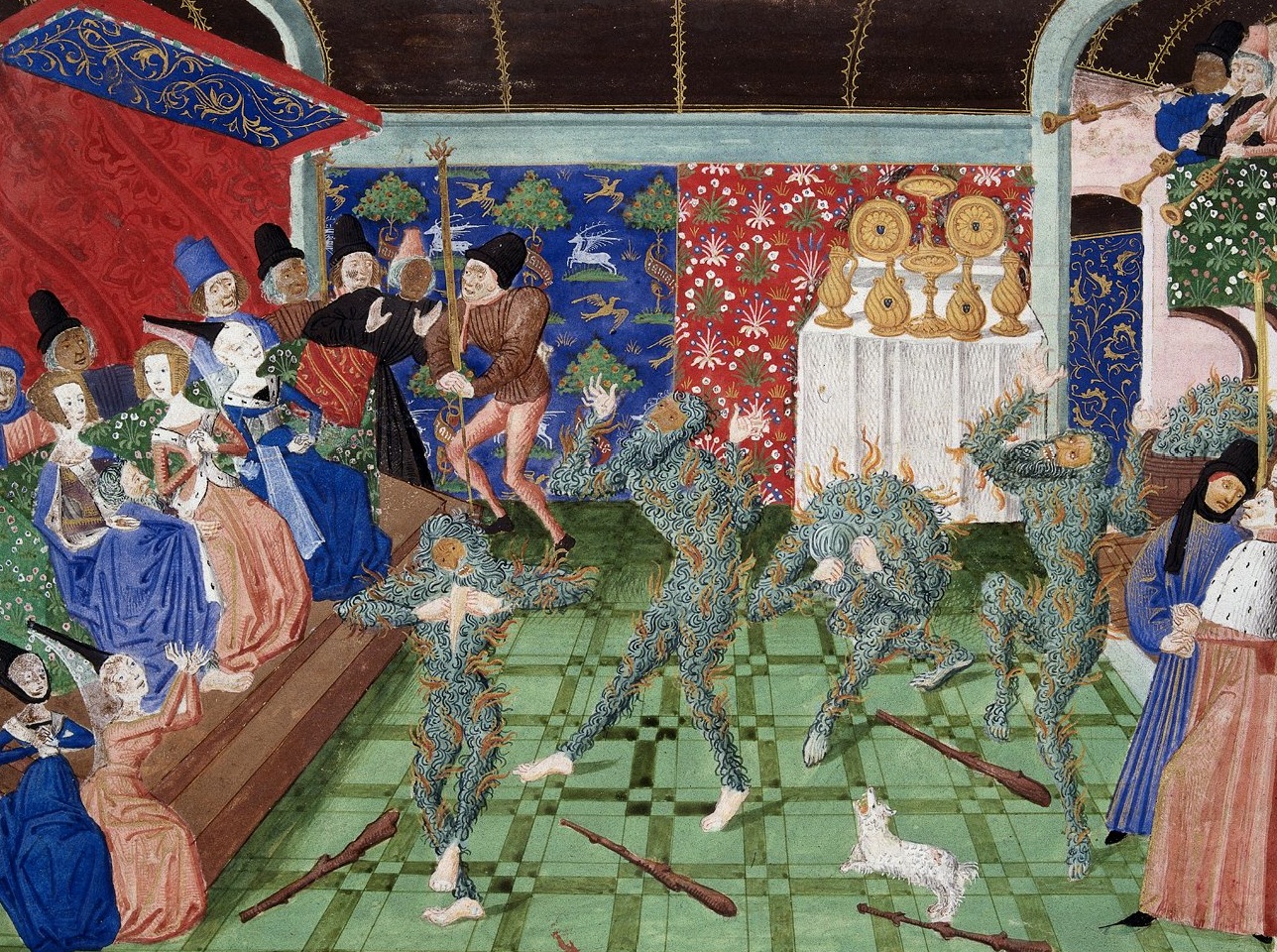
When I read about what was happening in the second painting, my attitude changed. It depicts a masquerade party gone horribly wrong.
King Charles and five dancers had dressed up as “shaggy forest creatures,” wearing linen suits coated in pitch and feathered with flax. The king’s brother Louis, drunk and arriving mid-dance, tried to inspect one of the dancers with a torch, and the costumes went up one after another.
The king was the only one who didn’t catch fire. His quick-thinking aunt hid him under the billows of her skirt. One dancer saved himself by leaping into a vat of wine, and the other four died of their terrible burns.
It was only a few weeks after this incident that Charles ordered his attendant to sew iron rods into his clothes.
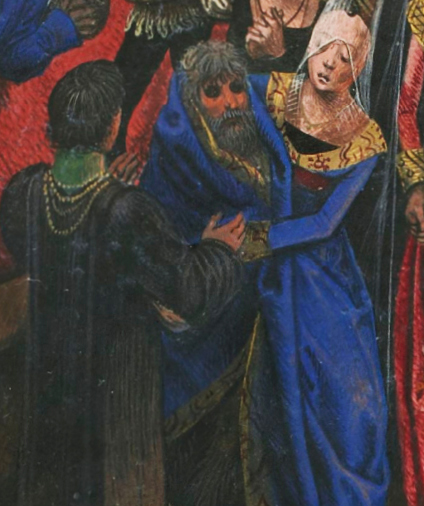
The previous summer, he’d been involved in another tragic incident. While the king was riding with some of his men, a commoner ran up to him and warned him he was about to be betrayed. A man-at-arms dropped his sword at that moment, and the king spun and killed him. He charged at his other men, presumably thinking they were assassins, killing four of them before being dragged from his horse.
Charles was catatonic with despair for days following the incident, and slowly improved over the autumn. The masquerade party, in January, was meant to cheer him up.
Reading about all this made me feel embarrassed. I had always seen the royal-class people in those paintings as out-of-touch fools at best. One of them going mad and thinking he’s a turkey or a glass decanter fit this prejudice perfectly. I didn’t quite see them as people with minds and hearts like mine. By title Charles was a powerful king, but he was also an overwhelmed young man, lying in bed, wracked with guilt, afraid someone might bump him and shatter him for good.

It’s easy to dismiss someone’s anxiety when you think they’re delusional. Of course you’re not a glass pitcher who might spill everywhere. Why don’t you worry about real problems? A guy at work is distraught because the FBI is monitoring him through old TV antennas. A college student is certain the communist revolution will free the world from oppression, and she’s terrified it won’t come soon enough.
Everyone lives in their own mental world, and each of us is certain of things that others can see are delusions. But we’re all completely entangled in our stories, and even if the facts are wrong, the anxiety each person feels is as real as the floor beneath them. We know how vulnerable we are, and how easily things go wrong, so we fixate on any story that feels like a path to safety.

When you regard someone as having the wrong beliefs, contempt comes easily, even ill will. How could they think that?! But I think it’s worth focusing on the reality of their anxiety instead, because that’s the real common ground.
That line of thinking often occurs to me when I’m stuck in traffic. Everybody wants to move, nobody can, and it always seems like someone else’s fault. Over the years I developed two tricks for managing your impatience with other drivers. When you notice you’re getting indignant, you can do one or the other or both.
The first one is to imagine that the person in the offending car is your aunt. She might turn too wide, signal late, or be slow to react to the green light. She’s not the best driver, no. But she doesn’t deserve your contempt.

The second one is similar but broader. You picture all the cars around you as being driven by creatures that are as breakable as fine china. Even though everyone is zipping around in these high-tech machines, the drivers inside are all very delicate. Just like you, even a mean word could wound them for a long time. No matter what people believe, everyone is made of glass.
***
 I'm David, and Raptitude is a blog about getting better at being human -- things we can do to improve our lives today.
{ 19 Comments }
I feel like these 2 approaches to motorists are also very similar to (or a variant of) the Secret Ally practice from Raptitude Field Trip.
My most common usage of that practice was to direct it at motorists and say ‘Hang in there little buddy! I hope you make it on time!’
Yes, same sort of thing. Letting annoyance trigger you into changing your conscious relationship to the stranger.
Seems like I missed a great Field Trip there… Again and again, it is road rage that puts my otherwise relatively level head to the test, specifically being on the receiving side of things. So these last two recommendations will be with me on my next drive. With all the wonderfully practical advice here, it would be great to read something like ‘David’s guide to road rage’ some day.
Do you know the book Lazar by Nelio Biedermann?
I don’t know that one, no
Jack Kornfield’s book “Buddha’s Little Instruction Book” has a similar exercise: “Imagine that every person in the world is enlightened but you. They are all your teachers, each doing just the right things to help you learn perfect patience, perfect wisdom, perfect compassion”
PERFECT! When I first became a card-carrying Christian (‘scuse the term), I handled situations by remembering the verse, “Do not neglect to show hospitality to strangers, for by so doing some people have entertained angels without knowing it.” –Hebrews 13:2
Ah interesting. This also appeared in Don’t Sweat the Small Stuff. I presume Carlson got it from Kornfield.
What a twisty tight turn (beautiful) almost exactly opposite mine: “how many times have I made that exact n’sais-pas” myself – oh, I so hate honkers!
By the way; reality only takes yes for an answer should have flags emblazoned with that motto
“Be kind, for everyone you meet is fighting a hard battle.” Reverend John Watson, a Scottish author and theologian.
“Have compassion for everyone you meet,
even if they don’t want it. What seems conceit,
bad manners, or cynicism is always a sign
of things no ears have heard, no eyes have seen.
You do not know what wars are going on
down there where the spirit meets the bone.”
– Miller Williams
Whenever I find myself feeling impatient with someone for driving slower than I want them to, I remind myself that they might have a poorly kitten or other beloved pet in a carrier on the seat beside them, and they are doing their slow and gentle driving on the way to the vet, as I do when I take our frightened cat.
Lovely and fascinating article, thanks David
I imagine every driver that makes choices I don’t appreciate are experiencing active diarrhea and urgently need to get home/to a doctor.
Good luck, buddy.
The turn in this essay is the thing. It opens as comedy — a king with iron rods sewn into his clothes, a nobleman afraid of pouring himself out of his own pitcher shape — and then the Bal des Ardents lands, and the laughter curdles: Charles stops being a mad king and becomes an overwhelmed young man who’d killed four of his own men and couldn’t trust the world not to bump him. I help run Arrow Games Go, a small site for free browser games, and the miniature version lands in our inbox weekly: players apologizing at length for being stuck on a level, as if a puzzle could shatter them. The glass is different, the careful handling isn’t.
Thanks for writing “Everyone is Made of Glass” with actual detail. I especially noticed “Facebook Email 3 Pinterest Reddit Share 3 SHARES I…”; separately, that’s story-choice pacing I also look for in Tricky Story Level.
I did a three-day silent retreat in Thailand in September, and the lesson I came home with was that judgment is contempt, and the other side of that coin is compassion. Picturing every driver as fine china gets there from the traffic side. Do you know if Charles ever took the iron rods out of his clothes?
Although, by definition of this article, I am completely made out of glass, I still forget others are. I deny both. After this, I shall recognize that my overthinking could be valid when connected to the reality surrounding me. But also, it could hurt those who surround my said reality that matter most or even least to me.
this one changed how i see those old paintings too. It’s easy to laugh at a strange fear until you learn what happened right before it, and then it makes a sad kind of sense. Makes me wonder how many of the odd habits I notice in people are armour I just can’t see. gracias for this one.